
The dust has settled on the highly anticipated 2026 World Cup group stages, leaving fans in awe of some truly spectacular defensive masterclasses. We are taking a close look at the most unyielding backlines and the individual standout performers who anchored them under immense pressure. Notably, the United States Men's National Team showcased immense resilience, relying on disciplined defensive structures to navigate challenging matchups. Dive into the tactical brilliance and sheer physicality that defined the early phases of this global showdown.
Defensive Power Ranking: A metric that evaluates a player's overall defensive contribution, combining statistics such as tackles, interceptions, clearances, and positional discipline into a single comprehensive score. This ranking system helps identify the most impactful defenders in a tournament setting.
The Evolution of the Modern Defender
The conclusion of the 2026 World Cup group stage has offered a fascinating glimpse into the shifting paradigms of international football strategy. Gone are the days when a defender's sole responsibility was to blindly clear the ball out of the danger zone. Today's elite defensive stalwarts act as deep-lying playmakers, combining physical dominance with extraordinary technical proficiency. The evaluation reflects a clear preference for individuals who can seamlessly transition from breaking down opposition attacks to initiating devastating counter-offensives. This dual-threat capability has become the ultimate differentiator on the global stage.
Tactical Masterclasses and Rising Stars
When evaluating the standout performers, it is evident that tactical intelligence often outweighs pure athleticism. The highest-rated individuals demonstrated an uncanny ability to read the game, intercepting passes before they could evolve into genuine threats. We are seeing a new generation of versatile athletes who are equally comfortable stepping up into the midfield or tracking back to execute a crucial last-ditch tackle. The presence of seasoned veterans alongside relatively unknown prodigies near the pinnacle of the evaluation highlights how tournament pressure can forge entirely new heroes. Experience certainly plays a role, but raw talent combined with tactical discipline has proven to be a lethal combination.
The United States' Defensive Resilience
From an American perspective, the tactical evolution of the United States Men's National Team is particularly noteworthy. The US squad has traditionally relied on high energy and transitional play, but the recent group stage fixtures revealed a much more pragmatic and structured defensive approach. Players like Tyler Adams, who secured a highly commendable position in the evaluation, operated as an unrelenting shield ahead of the backline. His tireless work rate and intelligent positioning disrupted numerous attacking sequences, providing a stable foundation for the team. Furthermore, the defensive cohesion displayed by the US backline suggests a growing maturity and adaptability, traits that are absolutely essential for navigating the unforgiving knockout rounds.
Looking Ahead: The Knockout Phase
As the tournament progresses into the high-stakes knockout phase, the reliance on these defensive anchors will only intensify. The margin for error shrinks drastically, and a single positional lapse can lead to immediate elimination. The individuals who have excelled thus far will be thoroughly tested against the world's most lethal attacking forces. The upcoming clashes promise to be tactical chess matches, where the unyielding resolve of the backline will ultimately dictate which nations continue their quest for ultimate glory. It will be thrilling to witness how these defensive masterminds adapt to increasingly complex offensive strategies.
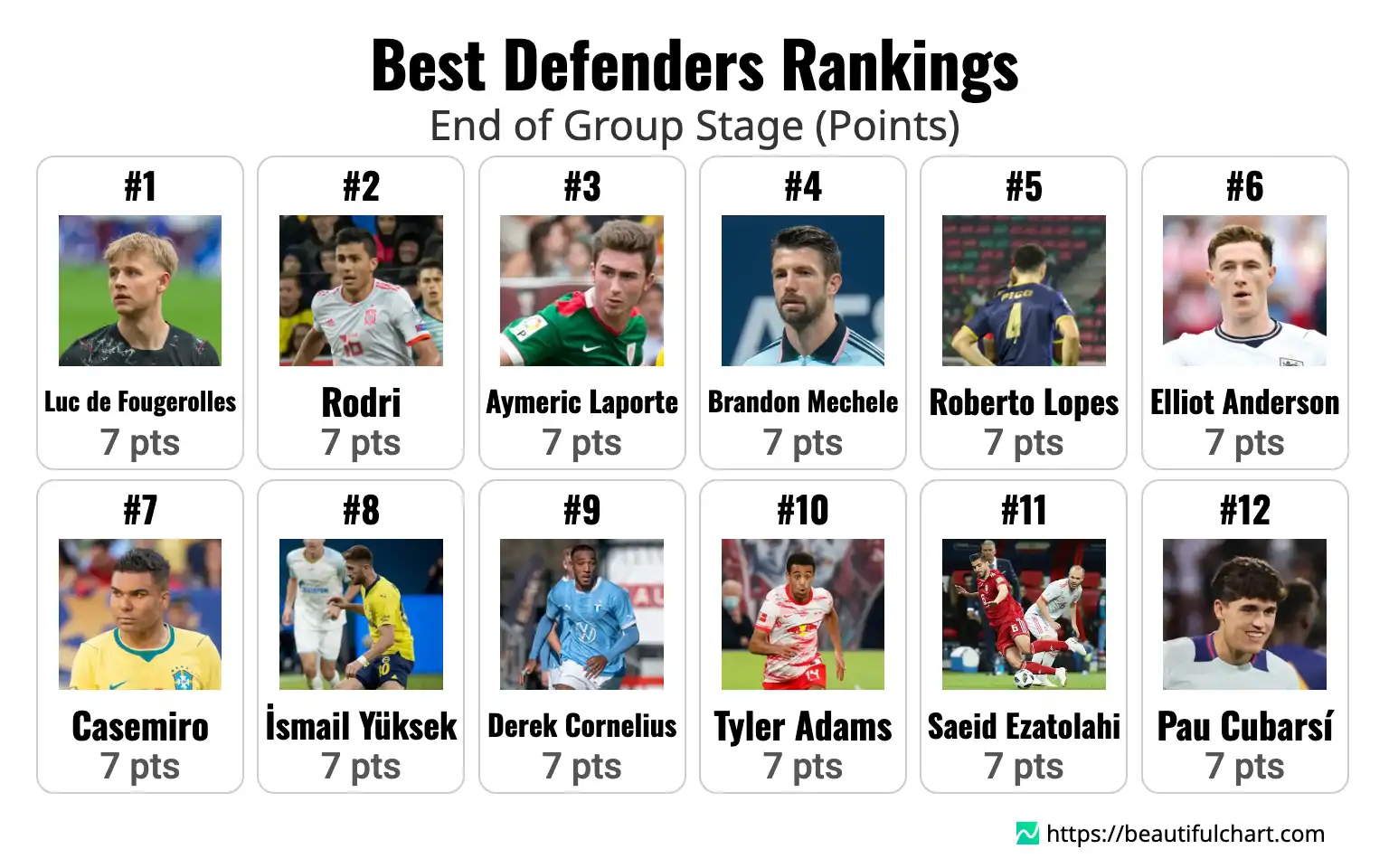
2026 World Cup Group Stage Top Defenders Power Rankings
The dust has settled on the highly anticipated 2026 World Cup group stages, leaving fans in awe of some truly spectacular defensive masterclasses.
Data Source: FIFA
Image Source: Freepik from www.flaticon.com
Key Takeaways
The Rise of the Playmaking Defender
- Modern defensive strategies heavily rely on players who can initiate attacks.
- Technical proficiency is now equally as important as traditional tackling skills.
- The ability to read the game and intercept passes dictates match tempo.
The Value of Tactical Discipline
- Successful national teams prioritize collective defensive structures over individual heroics.
- Positional awareness is crucial in neutralizing high-powered offensive threats.
- Teams that adapt their defensive shape based on the opponent tend to advance.
Standout American Contributions
- The US squad showcased significant improvements in defensive organization.
- Holding midfielders played a pivotal role in shielding the American backline.
- Tactical maturity indicates a strong foundation for future international success.
Top Ranking
#1 Luc de Fougerolles 7.38
Luc de Fougerolles emerged as an absolute revelation during the group stages, anchoring his team's defense with maturity well beyond his years. His exceptional reading of the game allowed him to consistently neutralize attacking threats before they materialized. Combining imposing physicality with remarkable composure on the ball, he orchestrated the play from deep, proving to be an impenetrable wall.
#2 Rodri 7.31
Operating primarily as a defensive shield, Rodri demonstrated why he is considered one of the most intelligent players in modern football. His positional awareness was nothing short of extraordinary, constantly disrupting opposition passing lanes while maintaining possession under immense pressure. He served as the vital connective tissue between defense and midfield.
#3 Aymeric Laporte 7.26
Aymeric Laporte brought invaluable experience and elegance to his squad's backline. Known for his elite distribution skills, he acted as a deep-lying playmaker, effortlessly breaking high presses with precise, incisive passing. His aerial dominance and crucial interventions during critical moments solidified his status as a world-class center-back.
#4 Brandon Mechele 7.24
Brandon Mechele delivered a series of incredibly disciplined performances, showcasing a traditional, no-nonsense approach to defending. His sheer tenacity in one-on-one situations and unwavering commitment to making decisive blocks frustrated opposing forwards throughout the group stage. He proved that grit and determination remain essential components of a successful defense.
#5 Roberto Lopes 7.22
Roberto Lopes proved to be a dominant force at the heart of the defense, consistently rising to the occasion in high-stakes encounters. His aggressive yet calculated tackling set the tone for his team, while his vocal leadership ensured the backline remained organized under heavy bombardment. His relentless work ethic made him a nightmare for attackers.
| Rank | Name | Indicator | Subindicator |
|---|---|---|---|
1 |  Luc de Fougerolles Luc de Fougerolles | 7.38 | Attack - 427 |
2 |  Rodri Rodri | 7.31 | Attack - 479 |
3 |  Aymeric Laporte Aymeric Laporte | 7.26 | Attack - 309 |
4 |  Brandon Mechele Brandon Mechele | 7.24 | Attack - 381 |
5 |  Roberto Lopes Roberto Lopes | 7.22 | Attack - 447 |
6 |  Elliot Anderson Elliot Anderson | 7.18 | Attack - 234 |
7 |  Casemiro Casemiro | 7.12 | Attack - 424 |
8 |  İsmail Yüksek İsmail Yüksek | 7.06 | Attack - 296 |
8 |  Derek Cornelius Derek Cornelius | 7.06 | Attack - 491 |
10 |  Tyler Adams Tyler Adams | 7.01 | Attack - 538 |
11 |  Saeid Ezatolahi Saeid Ezatolahi | 6.97 | Attack - 302 |
12 |  Pau Cubarsí Pau Cubarsí | 6.91 | Attack - 492 |
12 |  Dayot Upamecano Dayot Upamecano | 6.91 | Attack - 560 |
12 |  Juan José Cáceres Juan José Cáceres | 6.91 | Attack - 249 |
15 |  Mohanad Lasheen Mohanad Lasheen | 6.90 | Attack - 469 |
15 |  Davinson Sánchez Davinson Sánchez | 6.90 | Attack - 449 |
15 |  Alessandro Circati Alessandro Circati | 6.90 | Attack - 398 |
18 |  Alex Freeman Alex Freeman | 6.89 | Attack - 48 |
19 |  Rúben Dias Rúben Dias | 6.88 | Attack - 539 |
19 |  Diney Diney | 6.88 | Attack - 405 |


