
The 2026 World Cup in North America has delivered some of the most dynamic football we have seen in years. Following the dramatic conclusion of the group stage, this chart reveals the players who lead the FIFA Power Ranking in the creativity index. By analyzing these key metrics, we can easily spot the playmakers who are breaking defensive lines and setting up crucial goal-scoring opportunities. It is fascinating to see how a blend of established stars and emerging talents are shaping the tournament's narrative.
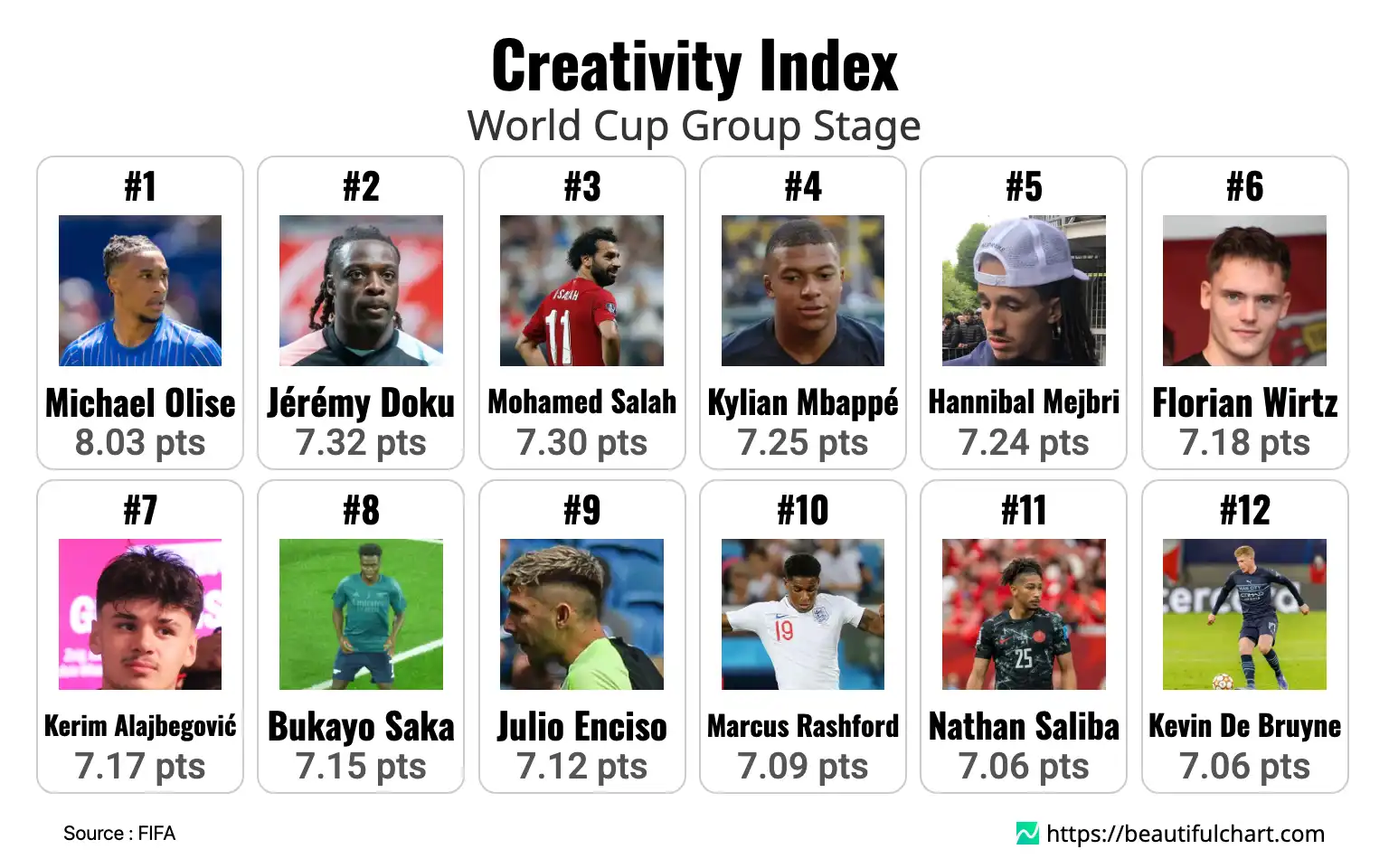
The creativity index is a specialized metric used to evaluate a player's ability to generate scoring opportunities and manipulate the opponent's defensive structure. It accounts for key passes, progressive carries, vision, and the execution of complex technical maneuvers under pressure.
The World Cup group stage has officially concluded, and the tactical evolution on display has been truly remarkable. As the initial phase wraps up across the stadiums in the United States, Canada, and Mexico, one thing is abundantly clear: the modern game is evolving faster than ever. We are seeing a massive shift in how teams approach the final third of the pitch. Gone are the days when you could just rely on a traditional number ten to stand in the middle and spray passes around. Today’s playmakers need to be dynamic, versatile, and incredibly intelligent to break down high-pressing, organized defenses.
Looking closely at the creativity scores emerging from this tournament's early phase, the data tells a compelling story about where football is heading. The players dominating the creative metrics are not simply sitting behind the strikers anymore. They are operating from the flanks, dropping deep into midfield, and sometimes even orchestrating play from defensive positions. This fluidity is making the tournament structurally fascinating to analyze, especially for fans who appreciate the tactical nuances of the sport. You can clearly see the trend shifting towards wide playmakers who possess the pace to beat a man and the vision to deliver a killer final ball.
The Evolution of the Playmaker Role
It is actually quite surprising to see how traditional tactical setups are being dismantled on the biggest stage. In previous tournaments, teams often built their entire offensive strategy around one central figure. Now, the creative burden is distributed. We are witnessing wingers functioning as primary creators, cutting inside to thread passes that split defenses wide open. This evolution requires a unique blend of technical mastery and spatial awareness. The players topping the creativity charts right now are those who can process information in fractions of a second. They know exactly where their teammates are going to be before they even receive the ball.
This shift is particularly evident when you consider the impact of intense pressing systems. Modern defenders give offensive players virtually no time on the ball. To succeed, attacking midfielders and wingers must have an elite first touch and the ability to execute complex ideas under immense physical pressure. The high creativity scores reflect individuals who have mastered this art, consistently turning chaotic midfield battles into structured, dangerous attacks.
Tactical Diversity Across the Tournament
Another fascinating aspect of the post-group stage analysis is the tactical diversity on display. European teams, South American giants, and rising forces from other confederations all have their unique ways of generating chances. However, the universal truth remains: you need players who can break the lines. Whether it is through a devastating dribble or a perfectly weighted through ball, the end goal is the same.
The influence of the host nations, particularly the United States, on the tournament's overall tactical landscape is also worth noting. The unique travel demands and varied climates across American venues have tested squad depth and physical conditioning, subtly influencing how international teams approach their offensive strategies. The expansive, physical nature of football often seen in North America seems to be pushing teams to adopt more direct, fast-paced transitions rather than slow, methodical build-ups. The world's most creative players are adapting beautifully to these environmental and tactical demands.
What This Means for the Knockout Stages
As we head into the knockout rounds, these creativity metrics will be more crucial than ever. When the stakes are highest, games are often decided by a single moment of brilliance to unlock a stubborn defense. Teams that boast players with elite creativity scores have a massive strategic advantage. They have the personnel capable of breaking down opponents who are perfectly happy to sit deep in a low block.
In conclusion, the group stage has proven that raw athleticism and defensive solidity must be paired with supreme offensive intelligence. The players who have topped the creativity metrics so far are dictating the rhythm of the tournament, proving that elite vision and passing accuracy remain the most valuable assets in world football. It will be fascinating to observe how these tactical trends develop as the competition progresses into its most critical phase.
2026 World Cup Group Stage
The 2026 World Cup in North America has delivered some of the most dynamic football we have seen in years.
Data Source: FIFA
Image Source: Freepik from www.flaticon.com
Key Takeaways
Tactical Shifts
- Wingers are increasingly taking on the primary playmaker role, moving away from central dominance.
- Elite first touches and spatial awareness are critical against modern high-pressing defenses.
- The creative burden is now distributed among multiple players rather than relying on a single number ten.
Tournament Dynamics
- The unique climates and travel demands across North American venues are testing squad depth and tactics.
- Tactical diversity is high, but the universal need for line-breaking passes remains the ultimate game-changer.
- The teams with top creative talents hold a significant advantage heading into the tight knockout stages.
Top Ranking
#1 Michael Olise 8.03
Michael Olise has been an absolute revelation during the group stage, leading the pack with an astonishing creativity score. His ability to drift inside from the flank and dictate the tempo of the game is unmatched. Olise combines elegant dribbling with pinpoint crossing, making him a constant nightmare for opposition fullbacks. His vision allows him to spot passing lanes that others simply do not see.
#2 Jérémy Doku 7.32
Jérémy Doku brings a completely different flavor of creativity, built on explosive pace and relentless directness. He thrives in one-on-one situations, constantly unbalancing defenses and creating chaos in the final third. Doku's high index score reflects his knack for breaking defensive lines through sheer dribbling ability, drawing multiple defenders and freeing up vital space for his teammates.
#3 Mohamed Salah 7.3
Mohamed Salah continues to prove why he is considered one of the premier attackers of his generation. While known for his goal-scoring, his creative numbers post-group stage are spectacular. Salah has evolved his game, often dropping slightly deeper to orchestrate attacks with his phenomenal left foot. His experience and calmness under pressure allow him to execute intricate passes effortlessly.
#4 Kylian Mbappé 7.25
It is no surprise to see Kylian Mbappé near the top of this list, as his mere presence alters how defenses operate. Beyond his frightening speed, Mbappé's decision-making in the final third has been incredibly sharp. He expertly uses the threat of his pace to backpedal defenders before slipping clever balls into the box, proving he is just as dangerous providing assists as he is scoring them.
#5 Hannibal Mejbri 7.24
Hannibal Mejbri has been one of the breakout stars in terms of pure midfield orchestration. Operating with a fiery passion, he combines aggressive ball-winning with exceptional progressive passing. Mejbri's high creativity index is a testament to his bravery on the ball; he is never afraid to attempt the difficult, line-breaking pass that instantly turns a defensive posture into a counter-attack.
| Rank | Name | Indicator | Subindicator |
|---|---|---|---|
1 |  Michael Olise Michael Olise | 8.03 pts | Attack - 86 |
2 |  Jérémy Doku Jérémy Doku | 7.32 pts | Attack - 100 |
3 |  Mohamed Salah Mohamed Salah | 7.30 pts | Attack - 26 |
4 |  Kylian Mbappé Kylian Mbappé | 7.25 pts | Attack - 3 |
5 |  Hannibal Mejbri Hannibal Mejbri | 7.24 pts | Attack - 105 |
6 |  Florian Wirtz Florian Wirtz | 7.18 pts | Attack - 111 |
7 |  Kerim Alajbegović Kerim Alajbegović | 7.17 pts | Attack - 33 |
8 |  Bukayo Saka Bukayo Saka | 7.15 pts | Attack - 66 |
9 |  Julio Enciso Julio Enciso | 7.12 pts | Attack - 52 |
10 |  Marcus Rashford Marcus Rashford | 7.09 pts | Attack - 71 |
11 |  Nathan Saliba Nathan Saliba | 7.06 pts | Attack - 63 |
11 |  Kevin De Bruyne Kevin De Bruyne | 7.06 pts | Attack - 103 |
13 |  Brahim Díaz Brahim Díaz | 7 pts | Attack - 68 |
13 |  Arda Güler Arda Güler | 7 pts | Attack - 59 |
15 |  Sadio Mané Sadio Mané | 6.99 pts | Attack - 128 |
16 |  Antonee Robinson Antonee Robinson | 6.93 pts | Attack - 387 |
17 |  Vladimír Coufal Vladimír Coufal | 6.90 pts | Attack - 203 |
18 |  Ramin Rezaeian Ramin Rezaeian | 6.86 pts | Attack - 19 |
18 |  Martin Ødegaard Martin Ødegaard | 6.86 pts | Attack - 104 |
20 |  Sebastian Berhalter Sebastian Berhalter | 6.85 pts | Attack - 35 |


