
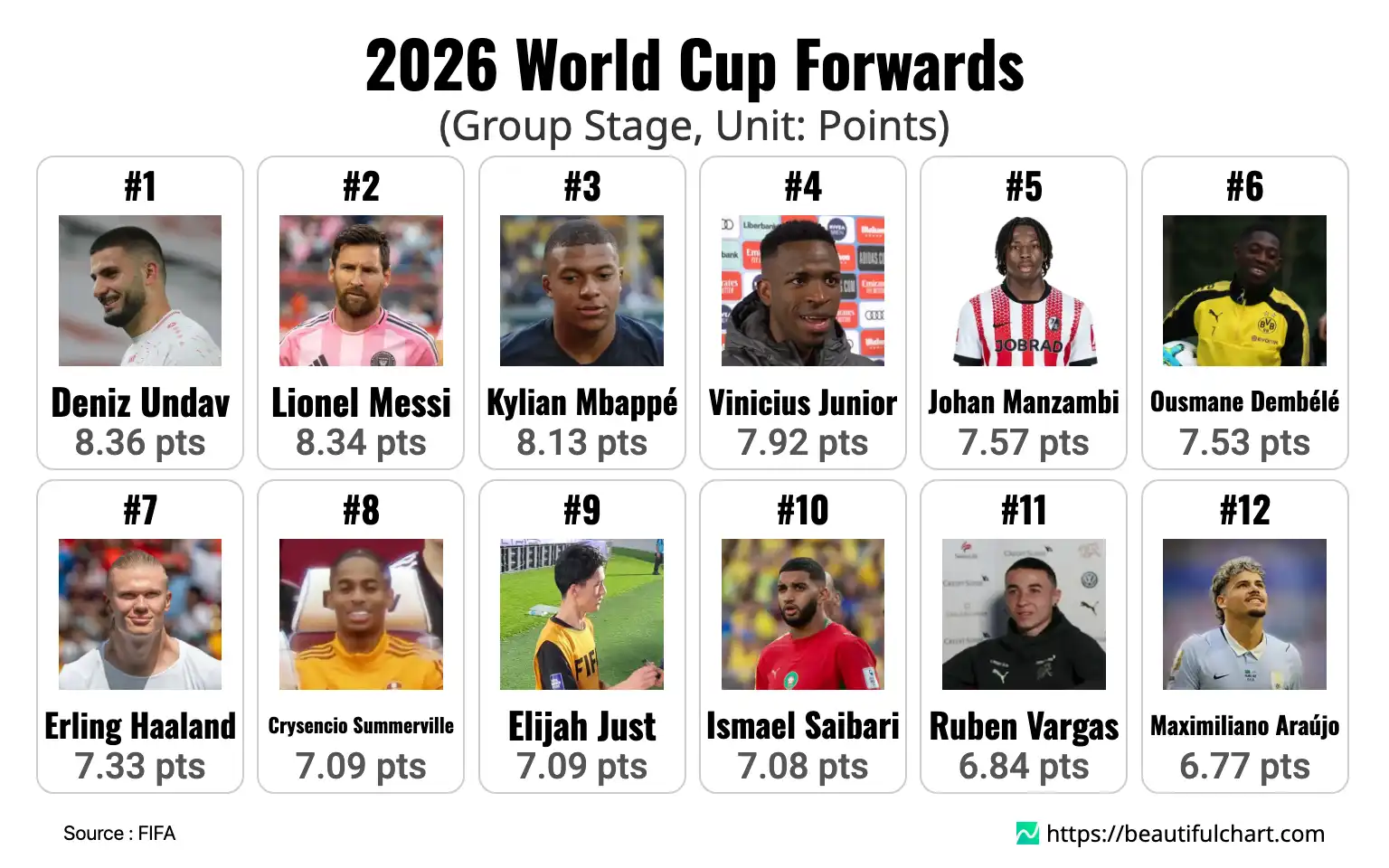
After the 2026 FIFA World Cup group stage wrapped up across the United States, Canada, and Mexico, the FIFA Power Ranking reveals a surprising shake-up at the top of the attacking charts. Deniz Undav edges out Lionel Messi for the number one spot with 8.36 points, while Kylian Mbappé and Vinicius Junior round out an elite top four. The list stretches across continents, featuring rising names alongside established superstars — making it one of the most diverse attacking rankings in World Cup history.
FIFA Power Ranking (Attacking): A performance-based scoring system used by FIFA to evaluate outfield players primarily in attacking roles. It factors in actions such as goals, assists, key passes, dribbles, and overall offensive contribution during the tournament, assigning a cumulative point value to reflect each player's attacking impact.
An Unexpected Name at the Summit
When most football fans picture the top of a World Cup attacking ranking, names like Messi, Mbappé, or Vinicius Junior come to mind instantly. So it genuinely turns heads when Deniz Undav — the German-born forward who has steadily built his reputation in club football — lands at #1 with 8.36 points. Just 0.02 points ahead of Lionel Messi, Undav's performance across the group stage was relentlessly direct, high-energy, and statistically dense enough to top even the greatest of all time. This isn't a fluke result — it's what happens when tournament form, pressing intensity, and goal contributions all align at exactly the right moment.
The Immortals Still Showing Up
Messi at #2 (8.34 pts) and Mbappé at #3 (8.13 pts) remind everyone why they remain the reference points for world-class attacking play. Messi, now well past the age when most players have retired from international football, continues to produce numbers that defy logic. His 8.34-point total reflects not just goals or assists, but the kind of all-round attacking orchestration that no data model fully captures — though the model clearly sees enough to place him second in the world. Mbappé, meanwhile, brought his trademark blend of explosive pace and clinical finishing to the North American stages, cementing his status as the most dangerous runner in the game. Vinicius Junior at #4 (7.92 pts) adds yet another layer to what is an extraordinary top tier.
Surprises in the Top 10
Below the elite four, the ranking gets genuinely interesting. Johan Manzambi at #5 (7.57 pts) and Crysencio Summerville at #8 (7.09 pts) represent the tournament's breakout narratives — players who used the World Cup stage to announce themselves to a global audience. Ousmane Dembélé (#6, 7.53 pts) and Erling Haaland (#7, 7.33 pts) are established stars, but Elijah Just (#9, 7.09 pts) and Ismael Saibari (#10, 7.08 pts) are names that casual fans are now rushing to look up. This pattern — elite stars mixed with genuine discoveries — is what makes a World Cup attacking ranking so compelling compared to a mid-season club list.
The United States Connection
With the 2026 World Cup hosted across the United States, Canada, and Mexico, there was enormous pressure on North American players to perform on home soil. The rankings reflect some of that energy. Sebastian Berhalter (#35, 6.15 pts), Cyle Larin (#17, 6.67 pts), and Folarin Balogun (#50, 5.92 pts) all appear in the Top 100, signaling that CONCACAF representation is no longer a footnote in these rankings. Alex Freeman (#48, 5.94 pts) and Auston Trusty (#61, 5.85 pts) add further depth to the American and broader North American presence. The host nation atmosphere clearly fed into performances, and the data supports it.
Mid-Table Depth and Global Spread
From ranks #20 through #70, the list reads like a tour of global football. Riyad Mahrez (#21), Mohamed Salah (#26), Lamine Yamal (#27), and Harry Kane (#25) represent the premium tier of established internationals. Arda Güler (#59), Brahim Díaz (#68), and Michael Olise (#86) point toward the next generation still maturing into their best football. The diversity here — spanning Africa, Asia, Europe, South America, and North America — underscores the genuinely global nature of the 2026 tournament, which expanded to 48 teams and created more opportunities for players from less traditional footballing nations to log meaningful minutes.
The Veterans Hanging On
One of the more poignant data points is Cristiano Ronaldo appearing at #79 with 5.72 points. At this stage of his career, simply making a Top 100 attacking ranking at a World Cup is a statement. Romelu Lukaku (#74, 5.75 pts) and Marko Arnautović (#31, 6.19 pts) are other experienced forwards who contributed meaningfully despite not being in their physical prime. Meanwhile, Viktor Gyökeres (#65), Bukayo Saka (#66), and Jonathan David (#54) represent the generation that will define international football for the next decade.
What the Numbers Tell Us
The scoring range — from 8.36 at the top down to 5.49 for Jérémy Doku at #100 — shows a relatively compressed distribution. The gap between #1 and #100 is less than three points, which suggests that the group stage created conditions where a large number of attackers performed at a high level. No single player ran away with the data. That competitive density makes the rankings particularly meaningful: every name on this list genuinely earned their placement through consistent, measurable attacking output across multiple matches on the biggest stage in football.
FIFA Power Ranking
After the 2026 FIFA World Cup group stage wrapped up across the United States, Canada, and Mexico, the FIFA Power Ranking reveals a surprising shake-up at the top of the attacking charts.
Data Source: FIFA
Image Source: Freepik from www.flaticon.com
Key Takeaways
Deniz Undav's Surprise Dominance
- Undav finished #1 with 8.36 points, edging Messi by just 0.02 points
- His group stage performance combined pressing, goal contributions, and direct play
- The result challenges assumptions about which players "should" top World Cup rankings
Legends Still Competing at the Highest Level
- Messi (8.34), Mbappé (8.13), and Vinicius Junior (7.92) hold three of the top four spots
- Cristiano Ronaldo at #79 remains a functional attacking force on the international stage
- Veteran presence throughout the list confirms experience still counts in tournament football
North American and Emerging Nations Making Their Mark
- Host nation players including Berhalter, Balogun, and Freeman feature in the Top 100
- Manzambi, Summerville, Saibari, and Just broke into the elite ten as genuine surprises
- The expanded 48-team format created space for a broader range of nationalities to register high attacking scores
Top Ranking
#1 Deniz Undav 8.36 pts
Deniz Undav delivered the standout individual attacking performance of the 2026 World Cup group stage, finishing first in the FIFA Power Ranking with 8.36 points. The Germany forward combined relentless pressing, sharp movement in behind defensive lines, and consistent goal involvements to compile a data profile that outscored every other attacker in the tournament — including Lionel Messi by the narrowest of margins.
#2 Lionel Messi 8.34 pts
Lionel Messi at 8.34 points remains, by any measure, one of the two best attacking players in this tournament. His ability to create, finish, and dictate the tempo of attacks continues to generate elite statistical output. Finishing second overall — ahead of Mbappé, Haaland, and the rest of the world's forwards — is a result that few players at any age could match, let alone one playing at this stage of his career.
#3 Kylian Mbappé 8.13 pts
Kylian Mbappé's 8.13-point total placed him third among all attackers after the group stage. His combination of top-end pace, directness in one-on-one situations, and ability to finish from multiple positions made him one of the most dangerous forwards across every match he appeared in. The gap between Mbappé and Undav at the top is narrow enough that the final stages could easily reorder things.
#4 Vinicius Junior 7.92 pts
Vinicius Junior recorded 7.92 points to claim fourth place in the attacking rankings. The Brazilian winger brought his club-level explosiveness and unpredictability to the international stage, creating problems for defenders with his dribbling and off-ball movement. His score reflects a group stage in which he was consistently involved in Brazil's most dangerous attacking sequences.
#5 Johan Manzambi 7.57 pts
Johan Manzambi is the most notable discovery in the Top 5, finishing fifth with 7.57 points and establishing himself as one of the genuine breakout names of the 2026 tournament. His attacking output across the group stage — in terms of both volume and efficiency — placed him comfortably above dozens of more widely recognized forwards and signals a significant step up in his international profile.
| Rank | Name | Indicator | Subindicator |
|---|---|---|---|
1 |  Deniz Undav Deniz Undav | 8.36 pts | Creativity - 25 |
2 |  Lionel Messi Lionel Messi | 8.34 pts | Creativity - 72 |
3 |  Kylian Mbappé Kylian Mbappé | 8.13 pts | Creativity - 4 |
4 |  Vinicius Junior Vinicius Junior | 7.92 pts | Creativity - 79 |
5 |  Johan Manzambi Johan Manzambi | 7.57 pts | Creativity - 45 |
6 |  Ousmane Dembélé Ousmane Dembélé | 7.53 pts | Creativity - 39 |
7 |  Erling Haaland Erling Haaland | 7.33 pts | Creativity - 508 |
8 |  Crysencio Summerville Crysencio Summerville | 7.09 pts | Creativity - 30 |
8 |  Elijah Just Elijah Just | 7.09 pts | Creativity - 98 |
10 |  Ismael Saibari Ismael Saibari | 7.08 pts | Creativity - 127 |
11 |  Ruben Vargas Ruben Vargas | 6.84 pts | Creativity - 48 |
12 |  Maximiliano Araújo Maximiliano Araújo | 6.77 pts | Creativity - 23 |
12 |  Matheus Cunha Matheus Cunha | 6.77 pts | Creativity - 191 |
14 |  Jude Bellingham Jude Bellingham | 6.74 pts | Creativity - 196 |
15 |  Anthony Elanga Anthony Elanga | 6.72 pts | Creativity - 137 |
16 |  Brian Brobbey Brian Brobbey | 6.71 pts | Creativity - 523 |
17 |  Cyle Larin Cyle Larin | 6.67 pts | Creativity - 505 |
18 |  Yoane Wissa Yoane Wissa | 6.55 pts | Creativity - 287 |
19 |  Ramin Rezaeian Ramin Rezaeian | 6.52 pts | Creativity - 18 |
20 |  Daniel Muñoz Daniel Muñoz | 6.50 pts | Creativity - 386 |


